

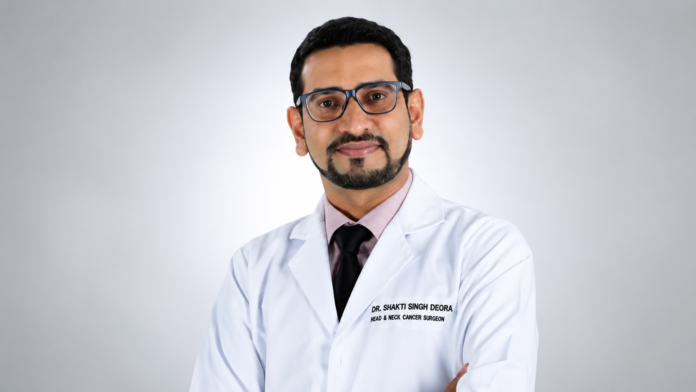

From a small town in Rajasthan to some of the world’s most respected centres for cancer and reconstructive surgery, Dr. Shakti Singh Deora’s journey has been shaped by one powerful idea: healing should not end with removing a disease-it should also restore a person’s function, dignity and quality of life.
Today, Dr. Deora is known for his work in Head & Neck Oncology and Microvascular Reconstructive Surgery, with a career spanning nearly two decades, international training, leadership roles and more than 1,000 microvascular reconstructive surgeries. Behind these achievements lies a longer story of discipline, continuous learning and a willingness to choose the more demanding path.
A Boy from Sirohi, Where Discipline Began Early
Long before the operating theatres, microscopes and complex reconstructive procedures, there was a young boy growing up in Sirohi, Rajasthan, surrounded by values that would eventually shape his professional life.
His early schooling took him to Bangalore Military School, an institution known for discipline, resilience and character-building. Those formative years gave him an environment where perseverance and responsibility became part of everyday life.
The Long Road of Learning
For Dr. Deora, education was never something that ended with a degree.
He built his medical foundation through MDS in Oral and Maxillofacial Surgery from VS Dental College and Kempegowda Institute of Medical Sciences, Bangalore, in 2009. His academic performance was recognised with the Prime Minister’s Scholarship.
In 2015, he pursued a fellowship in Head & Neck Oncology at Mahavir Cancer Sansthan in Patna, Bihar. A year later, he travelled to Taiwan to undertake a fellowship in Microvascular Reconstructive Surgery at Chang Gung Memorial Hospital.
His pursuit of advanced knowledge then took him to Germany, where he completed an AOCMF Fellowship at the University of Munich in 2017. His learning journey also included experience as an international visiting scholar at Memorial Sloan Kettering Cancer Center in New York, along with training at Tata Memorial Hospital in Mumbai.
Choosing the Harder Speciality
Head and neck cancer surgery presents a unique challenge. A surgeon may have to remove cancer affecting the face, jaw, tongue, throat or neck, but successful treatment cannot end there. Patients must also be able to speak, swallow, eat and live with as much normal function and dignity as possible.
This is where Dr. Deora chose a particularly demanding path. He decided to master not only ablative cancer surgery, which removes the disease, but also microvascular reconstructive surgery, which rebuilds what the surgery has taken away.
For him, the job of a surgeon is not simply to help a patient survive. It is also to help that person return to life with the greatest possible function, confidence and dignity.
When a Medical Gap Became a Mission
Dr. Deora’s institution-building journey did not begin with a traditional business idea. It began with something he repeatedly observed in healthcare.
India carries a significant burden of oral and head-neck cancers, and patients from Gujarat and surrounding regions often had to travel outside the state to access surgeons with specialised expertise in both cancer removal and advanced microvascular reconstruction.
That gap became an opportunity to create something meaningful. Instead of simply asking what career would benefit him, Dr. Deora increasingly focused on what capabilities patients in the region needed.
His international fellowships were therefore not pursued simply for certificates or titles. They were investments in knowledge that could eventually be brought back and applied closer to home.
Building a Career, One Hospital at a Time
After years of specialised training, Dr. Deora began building his professional career across Ahmedabad’s cancer-care ecosystem.
Over nearly two decades, he worked as a visiting consultant and senior surgeon with several recognised healthcare institutions, including HCG Cancer Hospital, Narayana Hospital, Apollo Cancer Centre and Sterling Cancer Hospitals.
His responsibilities grew steadily with his experience. He later became Director and Senior Consultant at OOM Superspecialty Head & Neck Surgical Hospital and Research Centre, followed by a similar leadership role at Northwest Cancer Hospital’s Institute of Head & Neck Cancer Surgery in Ahmedabad.
The Challenges Behind the Achievements
Behind a career filled with international fellowships, conference presentations and more than 1,000 reconstructive surgeries were years spent training away from home-in Bangalore, Patna, Taiwan, Munich and New York.
There was also the emotional weight of treating patients whose cancers were sometimes diagnosed late, along with the challenge of building credibility in a competitive healthcare environment such as Ahmedabad.
Microvascular reconstructive surgery itself demands extraordinary precision. A single tiny blood-vessel connection performed under a microscope can determine whether an intricate reconstruction succeeds. The speciality therefore requires patience, concentration, resilience and an ability to perform consistently under pressure.
Milestones That Mark the Journey
Over the years, Dr. Deora’s work has been recognised through several important professional milestones.
He has delivered nine international scientific presentations at Head & Neck Oncology conferences, including conferences in Argentina, Seoul and Kolkata.
He has also been involved as a guest speaker, panelist and chairperson at numerous state and national medical conferences.
His professional journey includes recognition as a Certified MCh Surgical Oncologist, along with advanced AO Basic and Advanced Course training.
Beyond clinical work, he has taken on leadership responsibilities and serves as Secretary of the Asian Head & Neck Cancer Foundation, extending his contribution beyond individual patient care towards broader awareness and advocacy in head and neck cancer.
From Operating Theatre to Institution Building
As Dr. Deora’s experience grew, his role increasingly moved beyond individual surgeries.
His journey demonstrates how a specialised medical practice can evolve into a larger healthcare vision. By taking leadership positions and helping build specialised institutes, he contributed to creating environments focused specifically on head and neck cancer surgery.
The journey was not built around a single dramatic breakthrough. It was built through years of expertise, patient trust and consistent work.
Today: Continuing the Mission in Ahmedabad

Today, Dr. Deora practises at Central Cancer Hospital in Ellisbridge and is associated with Compass Cancer Hospital in Ahmedabad.
His work aligns closely with a philosophy of comprehensive cancer care, personalised treatment, transparent communication, evidence-based decision-making and strong post-treatment support.
Care That Restores, Not Just Cures
At the heart of Dr. Deora’s vision is a simple but powerful philosophy: Cancer care should restore, not merely cure.
Survival is central to cancer treatment. But for patients affected by head and neck cancer, quality of life can be equally important.
The ability to speak clearly, swallow, eat with family, maintain facial structure and regain confidence can profoundly influence life after treatment.
This is why Dr. Deora’s continued pursuit of reconstructive expertise is so significant. He sees function, appearance and dignity as integral parts of successful treatment.
Lessons for Aspiring Professionals and Entrepreneurs
Build skills deliberately. Every fellowship he pursued had a purpose. He did not collect qualifications simply to add titles to his name. He pursued specific capabilities that could help him serve patients better.
Choose the difficult path when it creates greater value. Mastering both cancer removal and reconstruction is harder than specialising in only one. But patients benefit when both capabilities come together.
Turn a gap into a mission. Instead of simply noticing that specialised care was limited in the region, Dr. Deora spent years acquiring the expertise required to help close that gap.
Be patient with institution-building. His progression from consultant to senior surgeon, director and institute leader happened over years of consistent work.
Focus on the work, not only the recognition. The surgeries, conferences, leadership roles and professional recognition became outcomes of the work rather than the sole purpose behind it.
The Scalpel and the Spirit
Dr. Shakti Singh Deora’s story is ultimately not just about surgery. It is about discipline, curiosity, resilience and purpose.
From Sirohi to Bangalore, Patna, Taiwan, Munich and New York, his journey has been one of continuously going further—learning another skill, taking on another challenge and finding another way to serve patients better.
He chose a speciality where precision matters, where the stakes are high and where success requires both technical excellence and emotional understanding.
Today, after more than 1,000 microvascular reconstructive surgeries, international academic contributions, leadership positions and years of patient care, his philosophy remains remarkably grounded:
Treat the disease, but never forget the person living with it.
That is the spirit behind the scalpel-and perhaps the most enduring legacy of Dr. Shakti Singh Deora’s journey.
